Keir Starmer put on the spot at PMQs as he is urged to save assisted dying law

Prime Minister Keir Starmer has faced mounting pressure during Prime Minister’s Questions to ensure that landmark assisted dying legislation is not derailed by opponents in the House of Lords.
The urgent plea comes as the Terminally Ill Adults (End of Life) Bill faces what could be its most challenging parliamentary hurdle yet, with fears growing that technical procedures and a record number of amendments could prevent the legislation from becoming law.
At PMQs, Labour MP Kim Leadbeater—who has shepherded the Bill through the Commons—asked the Prime Minister whether he agreed that if the law is to change on assisted dying, it is extremely important to implement that change as soon as it is safe and practicable to do so.
The question underscored mounting concerns that the Bill, which has already cleared the House of Commons, could be stalled or blocked in the upper chamber despite enjoying significant public support.
A Promise to Dame Esther Rantzen
The assisted dying debate carries particular emotional weight for the Prime Minister. In March 2024, Starmer pledged to give MPs a vote on assisted suicide if Labour won the general election, and in October 2024, he said he was “pleased” that there would be a vote, as it allowed him to keep his promise to his friend Esther Rantzen.

Dame Esther, the renowned broadcaster and campaigner who has terminal lung cancer, has become the public face of the campaign for assisted dying reform in the UK.
In December 2023, she revealed she had joined the assisted suicide clinic Dignitas in Switzerland where it is legal and permits foreigners to use the service, a disclosure that prompted leaders of the main political parties to facilitate parliamentary time for a bill.
Related Post: Kemi Badenoch Presses Keir Starmer on Income Tax Plans in Budget
Dame Esther has expressed that Sir Keir Starmer told her before he became prime minister that he would make sure she witnessed the debate, saying “I didn’t think it was possible, it’s happened, I’m astonished and deeply grateful.”
The Bill’s Journey Through Parliament
The legislation has already overcome significant obstacles. Labour MP Kim Leadbeater, who represents Spen Valley, was drawn first in the ballot for private members’ bills in September 2024 and announced on October 3, 2024, that she would introduce a bill on assisted dying. The Bill was formally introduced to the House of Commons on October 16, 2024.

After months of intense scrutiny and emotional debate, the Bill passed its third reading in the House of Commons in June 2025 by 314 votes to 291, a narrow majority of just 23 votes.
The legislation proposes to allow terminally ill adults over age 18 in England and Wales, who are deemed to have less than six months to live, to apply for an assisted death.
Following the successful vote in the House of Commons, the Bill was read in the House of Lords for the first time on June 23, 2025, passed its second reading on September 12, and entered the committee stage on November 14.
Record-Breaking Opposition in the Lords
The Bill now faces unprecedented opposition in the House of Lords. On November 14, 2025, the House of Lords began debating the Terminally Ill Adults Bill with nearly 1,000 amendments tabled, marking a record for the committee stage of any bill.
This extraordinary number has triggered fierce accusations from supporters that opponents are deliberately attempting to obstruct the legislation.
ITV News reports that 579 of the amendments have been laid by just 7 peers, and opponents are “degrouping” amendments—insisting that every amendment is individually debated even where several amendments are similar.
Supporters argue this is a deliberate filibustering strategy designed to run down the parliamentary clock and prevent the Bill from becoming law.
Lord Falconer, the bill’s sponsor in the Lords, has proposed just 35 amendments, while opponents have submitted over 800, including restrictive proposals like travel bans and increased medical assessments.
The stark disparity in amendment numbers has fueled claims that the opposition is not genuinely seeking to improve the legislation but rather to block it entirely.
Accusations of Procedural Obstruction
Advocacy groups supporting the Bill have been vocal in their criticism of what they perceive as obstructionist tactics. Richy Thompson, Director of Public Affairs and Policy at Humanists UK, stated: “This volume of amendments is not about improving the Bill, it’s about blocking it.
Assisted dying has already faced more scrutiny than any other private member’s bill in recent history.
What we’re seeing now is a deliberate attempt to derail a compassionate, popular reform that the public overwhelmingly supports.”
The concern among supporters is not merely about the number of amendments but the procedural mechanisms being employed. The accusation is that opponents are attempting to “strangle the bill by procedural delay,” with supporters believing a majority of the Lords will be frustrated by this strategy and want a proper debate.
Unlike the House of Commons Speaker, the Lords Speaker cannot expedite debate or force the grouping of similar amendments, leaving the process vulnerable to filibuster tactics by determined opponents who insist each amendment be debated individually.
Democratic Legitimacy Versus Upper Chamber Scrutiny
The debate in the Lords has crystallized a fundamental tension in the UK’s constitutional arrangements: the proper role of the unelected upper chamber when reviewing legislation that has passed the elected House of Commons with a clear, if narrow, majority.
Sixty-five peers have written to all lords, urging them not to block the bill, with the letter signed by prominent figures including Neil Kinnock, Ruth Davidson, and Robert Winston, reminding peers that “it is not our role to frustrate the clear democratic mandate” of the Commons.
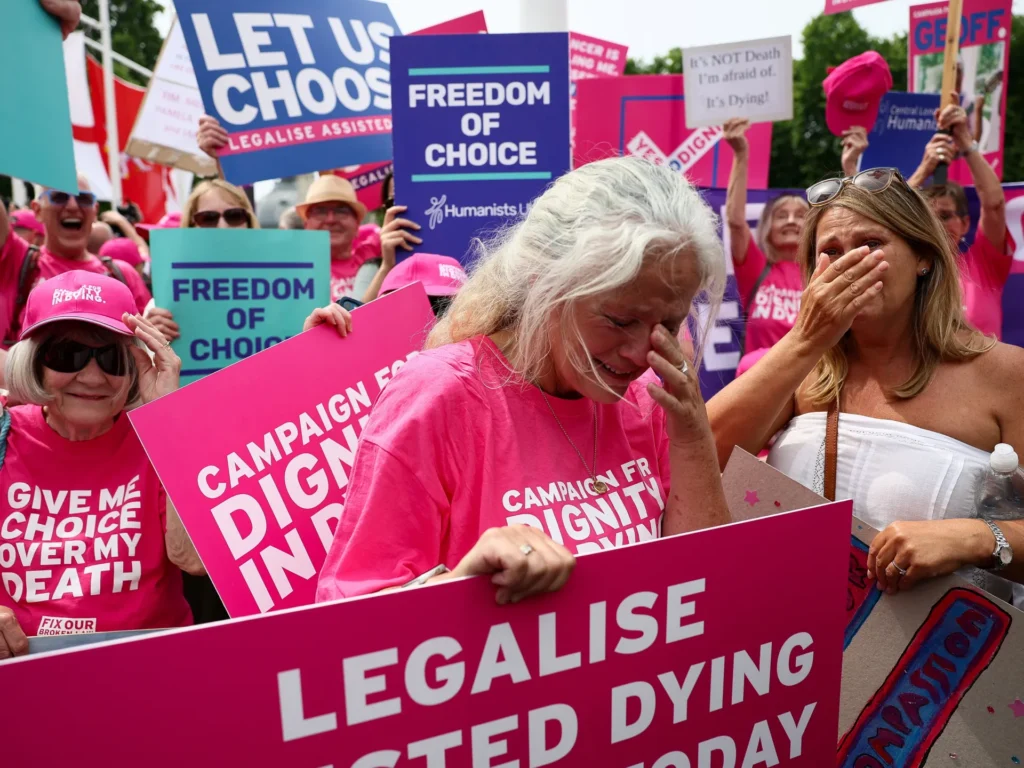
Dame Esther Rantzen has urged members of the House of Lords not to block the landmark legislation, telling BBC Radio 4: “I don’t need to teach the House of Lords how to do their job.
They know it very well, and they know that laws are produced by the elected chamber. Their job is to scrutinise, to ask questions, but not to oppose.”
However, opponents maintain their actions are justified given the life-and-death implications of the legislation. They argue that the Bill is fundamentally flawed and requires rigorous scrutiny, particularly given concerns about potential coercion of vulnerable people and the adequacy of safeguards.
The Prime Minister’s Careful Response
At Prime Minister’s Questions, Starmer walked a careful line in responding to Leadbeater’s concerns. He congratulated all colleagues working on the Bill and taking part in the debate, noting it is an important issue on which there are different views across the House and within parties, before stating that while the Bill is a matter for the House, it is the Government’s role to ensure that every piece of legislation that passes through Parliament is effective and workable.
The Prime Minister’s response reflected the government’s officially neutral stance on the Bill. The Starmer ministry took a neutral stance on the bill, giving Labour MPs a free vote, though Starmer himself voted in favour of the bill along with 15 members of his cabinet, while eight cabinet members voted against.

This internal division within the Labour government highlights the deeply personal and ethical nature of the assisted dying question.
The secretary of state for justice, Shabana Mahmood, and the secretary of state for health and social care, Wes Streeting, said they oppose the bill, with the latter arguing people feel an obligation to die.
What the Bill Proposes
The Terminally Ill Adults (End of Life) Bill represents what its supporters describe as one of the most restrictive assisted dying regimes proposed anywhere in the world.
To be eligible, applicants must be at least 18 years old, have lived in England or Wales for a minimum of 12 months, be registered with a general practitioner, and have a diagnosis from two independent doctors confirming a terminal illness with a prognosis of six months or less to live.
The Bill includes multiple safeguards designed to prevent coercion and ensure that only those who genuinely wish to end their lives, and who meet strict criteria, can access assisted dying.
Under the current proposal, terminally ill adults would need approval from two doctors and a panel comprising a psychiatrist, a social worker, and a senior lawyer before they could proceed.
The Bill stipulates that using dishonesty, pressure, or coercion on another person’s end of life decision carries a possible 14-year prison sentence. This provision aims to address one of the primary concerns raised by opponents: that vulnerable people might be pressured into ending their lives.
The Unprecedented Scrutiny
Supporters of the Bill argue it has already received far more parliamentary scrutiny than typical private members’ bills. Having received more time for scrutiny than most Government Bills in recent Sessions, the Bill was given a Third Reading in the House of Commons by MPs in June 2025.
The Bill has undergone extensive examination, including thousands of public responses and numerous evidence sessions. When it was first introduced to the House of Commons in October 2024, it spanned 32 pages of legal text comprising 43 clauses and six schedules.
By the time it was introduced to the Lords by its sponsor, Lord Falconer of Thoroton, on June 23, 2025, the Bill had grown to 51 pages, comprising 59 clauses and three schedules.
The committee examining the Bill in the Commons was selected by Leadbeater and made up of 23 MPs, 14 of whom supported the bill and 9 of whom opposed it. This composition ensured that opposing views were represented throughout the scrutiny process, though critics argued the balance favored supporters.
Concerns About Parliamentary Time
A critical factor in the Bill’s fate is the question of parliamentary time. The current parliamentary Session has been confirmed as unusually long and is expected to run until Spring 2026, likely April or May, providing additional sitting Fridays that can be scheduled in 2026.
However, private members’ bills face inherent disadvantages in terms of parliamentary time allocation. Even a small number of determined opponents is often enough to derail private members’ bills through procedural subterfuge and political game-playing.
Labour MP Kim Leadbeater, who steered the Bill through the Commons, told the PA news agency she hoped peers would not seek to derail the legislation, which could run out of parliamentary time if it is held up in the Lords, saying: “I would be upset to think that anybody was playing games with such an important and such an emotional issue.”
The reality is that if debate on the nearly 1,000 amendments drags on too long, the Bill could simply run out of time before the end of the parliamentary session, effectively killing the legislation without a formal vote against it—a procedural defeat that would spare opponents from having to publicly vote down legislation that enjoys significant public support.
The Human Stories Behind the Debate
Beyond the procedural battles and political maneuvering lie deeply personal stories that have shaped this national conversation. Louise Shackleton, who was investigated by police for accompanying her husband to Dignitas in Switzerland, described her experience: “I sat by my husband’s side as he made the most heartbreaking and dignified decision of his life.
He was suffering, and the only mercy left was to travel to Switzerland to end that suffering. For loving him enough to go with him, I was treated like a criminal.”
These personal testimonies have powerfully illustrated the human cost of the current legal framework, which criminalizes assistance in suicide even in cases where family members are supporting loved ones who are terminally ill and suffering.
Dame Esther Rantzen has told ITV News: “It won’t come in my lifetime, I won’t live long enough, but I am so relieved that it will help future generations to be able to look forward with hope and confidence to a good death.” Her advocacy has put a human face on what might otherwise be an abstract legal debate.
International Context
The UK is far from alone in grappling with these questions. Other countries that have legalized assisted suicide include Australia, Belgium, Canada, and parts of the United States, with regulations on who is eligible varying by jurisdiction.
Assisted suicide differs from euthanasia, which is allowed in the Netherlands and Canada and involves health care practitioners administering a lethal injection at the patient’s request in specific circumstances.
These international examples provide both encouragement for supporters, who point to functioning systems with appropriate safeguards, and caution for opponents, who cite concerns about “scope creep” in some jurisdictions where eligibility criteria have gradually expanded beyond the terminally ill.
The Opposition’s Concerns
While supporters emphasize compassion and individual choice, opponents raise serious ethical and practical concerns that cannot be easily dismissed.
A group of 27 Labour MPs who voted against the legislation stated: “We were elected to represent both of those groups and are still deeply concerned about the risks in this Bill of coercion of the old and discrimination against the disabled, people with anorexia and black, Asian and minority ethnic people, who we know do not receive equitable health care.”
These concerns reflect broader worries about whether the proposed safeguards are sufficient to protect vulnerable people from subtle forms of coercion, whether from family members seeking to relieve financial burden or from a healthcare system under resource pressure.
Critics also question whether the focus should instead be on improving palliative care services, ensuring that everyone has access to high-quality end-of-life care that can manage pain and suffering effectively without resorting to assisted dying.
What Happens Next
The Bill’s immediate future depends on how the House of Lords navigates the committee stage with its record number of amendments. Following an agreement between the sponsor of the Bill, Lord Falconer, and a key opponent, Baroness Berger, a special committee was established to scrutinise the Bill and report back to the house by November 7, 2025.
If the Bill survives the Lords’ committee stage, it will proceed to report stage and third reading before potentially becoming law—though any significant amendments would need to return to the House of Commons for approval.
Backers of the bill say implementation will take four years, rather than the initially suggested two. This extended timeline reflects the complex practical and administrative arrangements that would need to be established before assisted dying could become operational, including training for medical professionals, establishment of review panels, and creation of appropriate documentation and oversight systems.
The Broader Political Implications
The assisted dying debate transcends normal party political divides, creating unusual alliances and highlighting the complexity of conscience votes on matters of life and death. It may be that Keir Starmer thought the private members’ bill route to allowing the Commons a vote on assisted dying offered him the best of both worlds—making good his promise to Dame Esther Rantzen without provoking an internal row and tying up his government in a prolonged debate.
However, this approach has drawn criticism from governance experts who argue that such significant social legislation deserves the full weight of government backing rather than being left to the uncertainties of the private members’ bill process.
Conclusion
As Prime Minister Starmer faces pressure at PMQs to ensure the assisted dying bill’s passage, the fundamental question remains: will the House of Lords respect what supporters see as a clear democratic mandate from the elected chamber, or will procedural obstacles and substantive concerns about safeguards prove insurmountable?
The stakes could not be higher for those like Dame Esther Rantzen, who has campaigned tirelessly for this change, and for the millions of people across the UK who may one day face a terminal diagnosis and wish to have choice in how they die.
Dame Esther told peers: “So yes, people who are adamantly opposed to this bill, and they have a perfect right to oppose it, will try and stop it going through the Lords, but the Lords themselves, their duty is to make sure that law is actually created by the elected chamber, which is the House of Commons.”
Whether the Prime Minister’s commitment to allowing a vote will translate into actual legislation depends on events in the House of Lords over the coming months—events that will determine whether the UK joins other countries in legalizing assisted dying or whether this latest attempt at reform meets the same fate as previous efforts.
For now, all eyes remain on the upper chamber and the unprecedented battle over nearly 1,000 amendments that could make or break this landmark social legislation.
SEO KEYWORDS: Keir Starmer, assisted dying, PMQs, Kim Leadbeater, House of Lords, Dame Esther Rantzen, terminally ill, End of Life Bill, Parliament, UK legislation, assisted suicide, Westminster, private members’ bill, Lord Falconer
RELATED TOPICS: UK assisted dying law, Parliamentary procedure, House of Lords amendments, End of life care, Medical ethics, UK social legislation